Among ancient forests and monastic silence: a journey to the Hermitage of Camaldoli and the Sanctuary of La Verna, the two spiritual hearts of the Casentino.
Camaldoli and La Verna: the two sacred hearts of the Casentino
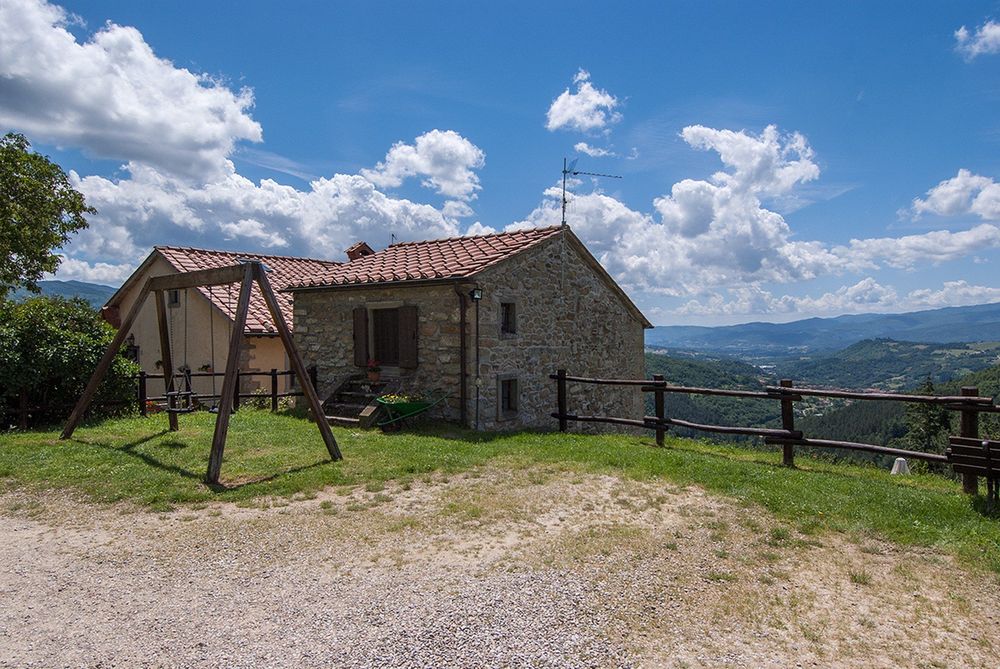
In the heart of the Casentino, among the forests that climb gently towards the Apennine ridge, lie two places that for centuries have drawn pilgrims, hermits and travellers in search of silence: the Hermitage and Monastery of Camaldoli and the Sanctuary of La Verna. Setting out from Borgo Tramonte to reach them means crossing the very same landscape of woods and valleys that for a thousand years has accompanied those who come here seeking something deeper than a simple view.
Camaldoli, the silence of San Romualdo
The story of Camaldoli begins around 1012, when the monk Romualdo da Ravenna, struck by the solitary beauty of the forest, obtained permission from Tedaldo, Bishop of Arezzo, to found a hermitage in a clearing not far from the Apennine ridge. The Hermitage was consecrated in 1027; in 1080 the hospice at the foot of the mountain became a Monastery, giving rise to the two faces that still coexist at Camaldoli today: the Sacro Eremo, higher up, the contemplative heart of monastic life, and the Monastery, a place of welcome for pilgrims and travellers.
From this community the Camaldolese order was born. The Monastery still preserves a historic pharmacy dating back to 1543, alongside a Baroque church enriched with works by Giorgio Vasari. Yet perhaps Camaldoli's most remarkable legacy is the one written into the woodland itself: as early as 1080 the prior Rodolfo set down the first rules of forest management, and in 1520 the monastery's printing house published the Regola della vita eremitica. For centuries the monks were attentive guardians of this woodland heritage, so much so that from the sixteenth century onwards the production of timber — in particular silver fir, prized as much for its economic value as for its symbolic meaning in meditation — became an integral part of monastic life. Today, in the forest that surrounds them, you will find an information point of the Parco Nazionale delle Foreste Casentinesi and the ornithological museum housing the Biggeri collection.
La Verna, the mountain given to Francesco
Towards the ridge that looks out over Romagna rises Monte Penna, a limestone crag that in May 1213 Count Orlando Cattani of Chiusi in Casentino, moved by the preaching of Francesco d'Assisi, gave in its entirety to the future saint. The first chapel, that of Santa Maria degli Angeli, was begun in 1216 and enlarged until 1260; but it is 17 September 1224 that made La Verna one of the most venerated places in Christendom: here Francesco received the stigmata, and the Cappella delle Stimmate, built around 1263, still preserves its memory today, together with the Corridoio delle Stimmate, created between 1578 and 1582.
In 1432 Pope Eugene IV entrusted the sanctuary to the Friars Minor of the Observance, under the patronage of the Florentine Arte della Lana, while the great Basilica, built between 1348 and 1509, was elevated to a minor basilica in August 1921. The friary holds what is described as the largest existing concentration of works by the Della Robbia, an artistic heritage that converses with the spirituality of the place just as much as the forest of beech and silver fir surrounding the sanctuary, which has remained almost untouched thanks to some eight centuries of Franciscan guardianship. It is no surprise that an ancient inscription reads: «Non est in toto sanctior orbe mons» — there is no holier mountain in all the world.
The municipality of Chiusi della Verna, home to the sanctuary, is the highest in Tuscany, at 954 metres above sea level; the Basilica itself stands at 1,128 metres, on the crag of Monte Penna.
A single path between two sacred forests
Camaldoli and La Verna both belong to the Parco Nazionale delle Foreste Casentinesi, Monte Falterona e Campigna, which also protects the ancient beech woods of Sasso Fratino, recognised as a UNESCO World Heritage Site. It is no coincidence that the Park offers excursions linking the two sanctuaries through the centuries-old woodland, passing through clearings such as the Cavalla Pazza, a refuge for deer, roe deer, wolves and wildcats, all the way to the great beeches and mossy boulders of the Macchia delle Ghiacciaia, at the foot of La Verna.
For those staying at Borgo Tramonte, devoting one day to Camaldoli and another to La Verna means discovering two different ways of inhabiting the same silence: communal life and the work of the land on one hand, the contemplation of rock and sky on the other. Two places that, together, tell better than any guidebook what it means, in the Casentino, to seek the essential.
<!-- sources: https://it.wikipedia.org/wiki/Santuario_della_Verna, https://it.wikipedia.org/wiki/Chiusi_della_Verna, https://en.wikipedia.org/wiki/Camaldoli, https://www.parcoforestecasentinesi.it, https://www.parcoforestecasentinesi.it/en/multimedia/interactive-map/place-to-visit/la-verna, https://www.parcoforestecasentinesi.it/it/event/camaldoli-e-la-verna, https://www.parcoforestecasentinesi.it/en/multimedia/interactive-map/place-to-visit/camaldoli-e-il-sacro-eremo -->