Chestnuts, the red potatoes of Cetica and tortelli alla lastra: a journey through the authentic flavours of the Casentino, among woods and watermills.
The Casentino at the table: a cuisine born of the forest and the labour of the fields
Long before it became a picture-postcard landscape, the Casentino was for centuries a world of woodlands, watermills and mountain communities who had to wrest their daily bread — often quite literally — from the soil and the chestnut groves. It is here that the cuisine still found on the valley's tables was born: humble in its history, immensely rich in flavour.
The bread that wasn't there: chestnut flour
Until the first half of the twentieth century, small watermills dotted the streams of the Parco Nazionale delle Foreste Casentinesi, grinding wheat, maize and chestnuts. In the mountain communities, where wheat was scarce, wheat flour was eked out with flours made from other cereals and dried pulses — and above all with chestnut flour, which for generations meant the difference between hunger and a warm meal. The miller, guardian of this fragile balance, kept a small percentage of the grinding as payment, the so-called "molenda": an indispensable figure and one regarded, in popular tradition, with a hint of suspicion.
Today that very flour, once a food of subsistence, has become a prized ingredient: the National Park still tells its story through excursions and events dedicated to the historic chestnut groves, such as the one at Montalto.
The Patata Rossa di Cetica, from famine to fine dining
If the chestnut speaks of the forest, the potato speaks of the field — and in the Casentino it goes by a very precise name: the Patata Rossa di Cetica. Grown on the hills of the Casentino side of the Pratomagno, above 500 metres in altitude, this variety with its pale red skin and white flesh flecked with red arrived in the valley in the nineteenth century, when a Lorraine edict encouraged potato cultivation to counter the famines afflicting the Grand Duchy of Tuscany. From emergency crop it has become a symbol of local identity: today the Patata Rossa di Cetica is recognised as a Traditional Agri-Food Product (P.A.T.) and has entered Slow Food's Ark of Taste, while a consortium founded in 2005 protects its name and quality.
In the kitchen it holds up beautifully to cooking and has a fine, delicate flavour: its natural destiny lies in gnocchi and tortelli di patate, two dishes that on their own tell the story of the valley's farming soul.
Tortello alla lastra, a celebration scented with embers
And it is the potato itself that takes centre stage in one of the Casentino's most emblematic dishes: the tortello alla lastra of Corezzo. A large sheet of hand-made pasta encloses a filling of mashed potatoes seasoned with onion, tomato and spices; the distinctive touch, however, lies not in the filling but in the cooking — on a scorching stone slab rather than in boiling water — an ancient gesture that makes it closer to a large mountain piadina than to a classic tortello. Every year in mid-August, Corezzo gathers around its Sagra del Tortello, and the tradition is also passed on through public workshops organised with the local Pro Loco, where every stage of the preparation is demonstrated, from the dough to the cooking on the lastra.
Cheeses, cured meats and the forest's quiet gifts
The Park's territory also safeguards a small constellation of dairy and pork products linked to the Casentino and Romagna: Pecorino Toscano, one of the oldest and most prized cheeses of the tradition, and Raviggiolo, a fresh cheese whose fame has been documented since 1515, when — as local tradition tells it — it was offered to Pope Leo X. Alongside the cheeses, cured meats such as Gota and Salsiccia Matta, also known as "ciavar", reveal another face of mountain cooking, that of the pig farming widespread between the Casentino and Romagna.
The forest, finally, also yields honey: that of mountain flowers and, more rarely, fir honeydew honey, dark, almost black, among the most singular products safeguarded by the Park.
At the table, in the evening, at Borgo Tramonte
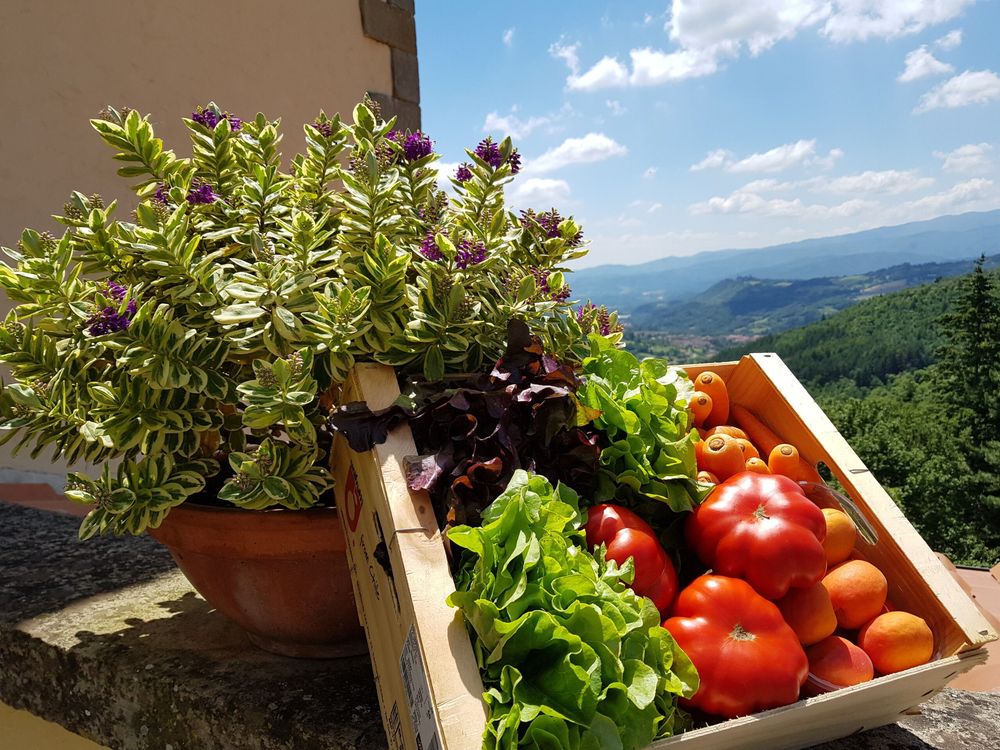
This is the very land that unfolds beyond the windows of Borgo Tramonte. At breakfast as at dinner, respect for the territory translates into a choice of ingredients that tell the story of the Casentino, quietly — with the same elegant discretion with which the valley has always guarded its recipes: a balance between the simplicity of its rural origins and the care of refined hospitality, where every dish is a gentle invitation to slow down and listen to the season.
<!-- sources: https://it.wikipedia.org/wiki/Patata_rossa_di_Cetica, https://www.parcoforestecasentinesi.it/it/vivi-il-parco/prodotti, https://www.parcoforestecasentinesi.it/it/news/il-mulino-e-il-mugnaio, https://www.comune.pratovecchiostia.ar.it/c051041/po/mostra_news.php?id=755&area=H -->