From the green awakening of spring to the belling of stags in autumn, all the way to winter's silent snow: how the Casentino changes, season after season.
A valley that lives by the seasons
The Casentino occupies the uppermost part of the Arno Valley, enclosed between the Pratomagno, the Alpe di Catenaia and, to the north, Monte Falterona, where the river rises at an altitude of 1,654 metres. It is, as Visit Tuscany describes it, "the wildest and most unspoilt part of Tuscany": centuries-old woods of beech, fir and chestnut climbing from the valley floor up to the ridges of the Foreste Casentinesi National Park. From Borgo Tramonte, immersed in this landscape, the rhythm of the seasons can be observed unhurriedly: every time of year tells the story of a different Casentino.
Spring: the forest awakens
After winter, the forest breathes again. The Foreste Casentinesi Park calls this moment "Primavera Wild": the intense green of beech leaves, mountain springs flowing once more, nature regaining its colour day after day. It is the season when the park offers excursions, events and workshops dedicated to biodiversity — an invitation to walk or cycle along trails that are still quiet. For those staying at Borgo Tramonte, this is the time when the Casentino reveals itself step by step, among woods filling with new green and villages preparing for the warmer months.
The climate of the valley floor
The Casentino valley floor has a temperate climate (Köppen classification Cfb); above 1,200 metres the climate takes on more continental characteristics, with greater temperature swings between day and night. These conditions mean that spring arrives more slowly at higher altitudes than on the valley floor, where the first mild days are felt earlier.
Summer: long days among woods and trails
Summer in the Park is described as "E...state con il Parco": holidays, sunshine, long days to be shared. Activities range from trekking to mountain biking, from horse riding or walks with donkeys to boat trips on Lake Ridracoli, always "amid ancient forests, within protected nature". It is the best season for climbing towards the ridges, where rainfall is more abundant than on the valley floor — exceeding 1,800 mm a year along the Tuscan-Romagnol ridge — seeking cool relief in the shade of the beech woods. In early September, as summer draws to a close, the Casentino also comes alive with events: in Stia, in the municipality of Pratovecchio Stia, the forges are fired up once again for the Biennale dell'Arte Fabbrile.
Autumn: foliage and the belling of the stag
Autumn is the season that the Foreste Casentinesi National Park describes quite plainly as "Autunno Slow", perhaps the most spectacular of the year. The forests catch fire with colour towards the end of October, in the "spectacle of the foliage": a mosaic of reds, ochres and golds sweeping across beech woods, chestnut groves and oak forests. Already from late September, the belling of the stag echoes through the woods, the call of the males at the height of the rutting season — an experience the park brings to life with guided listening excursions. It is also the season of flavours: mushroom foraging, chestnuts gathered with the help of donkeys, and the Tuscan-Romagnol mountain cuisine that fills the table. It is no coincidence that September, in the heart of the Casentino, is also the time of Casentino Armonico, the Pratovecchio Stia music festival that weaves together concerts, nature and sound research. From the rooms of Borgo Tramonte, autumn is lived almost entirely outdoors: walks among the colours, dinners that taste of the woods, evenings that slowly grow shorter.
Winter: snow, silence and endless horizons
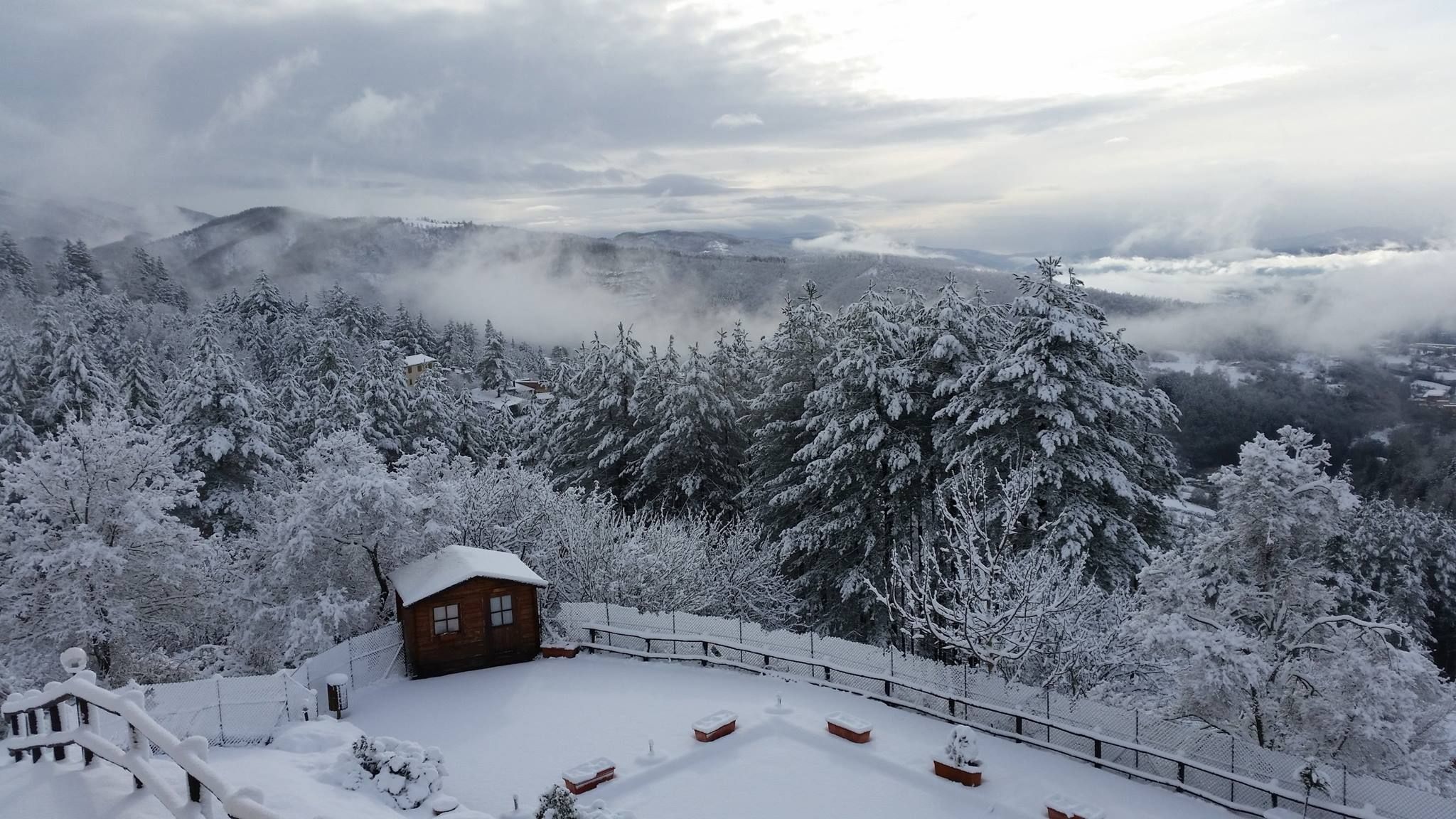
In winter the Park is transformed: snow, ice and frost redraw the ridgelines. The Foreste Casentinesi Park tells of it as an unexpected season, "Neve & Natura" — crisp air, horizons that on the clearest days stretch from the two seas to the arc of the Alps, and nights lit by the moon. It is not a season of waiting but — as the Park itself writes — "a season awaited for its intense emotions". At the highest altitudes snow can make some trails impassable, while on the valley floor the climate remains milder. It is the season when the Casentino reveals its most intimate side: the woollen fabrics of the celebrated panno casentino, in its historic orange and bottle-green hues, seem made for these very months, and the fireplace at Borgo Tramonte becomes the natural end point of every day spent among the snowy woods.
<!-- sources: https://it.wikipedia.org/wiki/Casentino, https://en.wikipedia.org/wiki/Casentino, https://www.parcoforestecasentinesi.it, https://www.parcoforestecasentinesi.it/it/vivi-il-parco/attivita/le-stagioni-del-parco, https://www.comune.pratovecchiostia.ar.it, https://www.visittuscany.com/en/areas/casentino/ -->